Addressing the Lack of Access to Surety and Bonding: Releasing the Untapped Potential of First Nations Contractors
Situation
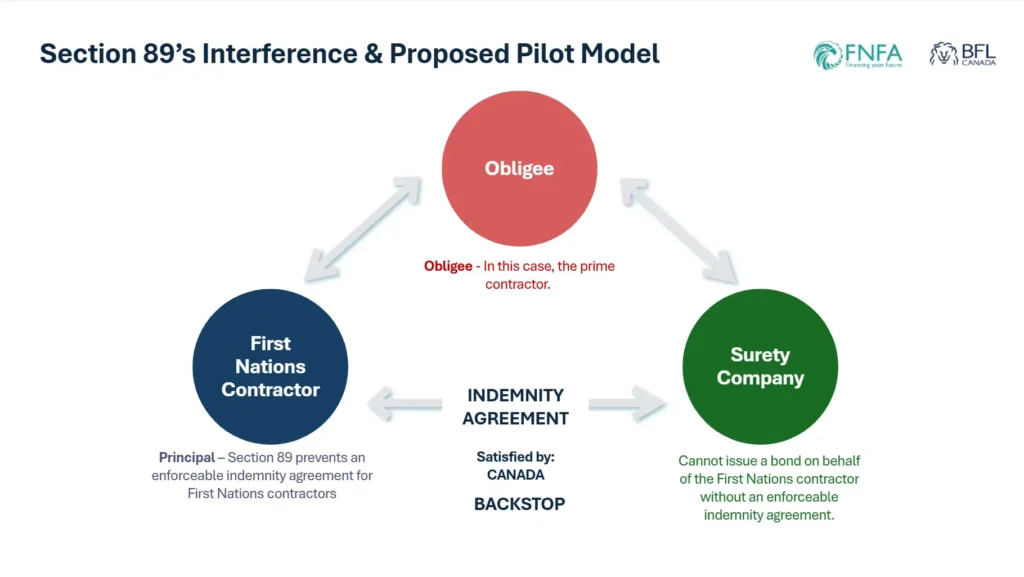
First Nation contractors with assets on reserve continue to face legislative barriers which prevent them from signing an enforceable indemnity agreement which is mandatory to obtain the surety and bonding insurance required for bidding on virtually all construction projects.
First Nations Finance Authority (FNFA) has called upon Canada to establish a backstop fund to provide a pathway for First Nations contractors to sign indemnity agreements. Change is needed now to ensure that First Nations contractors are prepared to participate in the move to close the growing infrastructure gap, currently quantified at $350 billion. Furthermore, this change is needed to ensure First Nations contractors who are located on reserve can participate in economic opportunities arising in their territories as part of Canada’s “build agenda”.
Complication: Why is a Backstop Needed for First Nation Contractors?
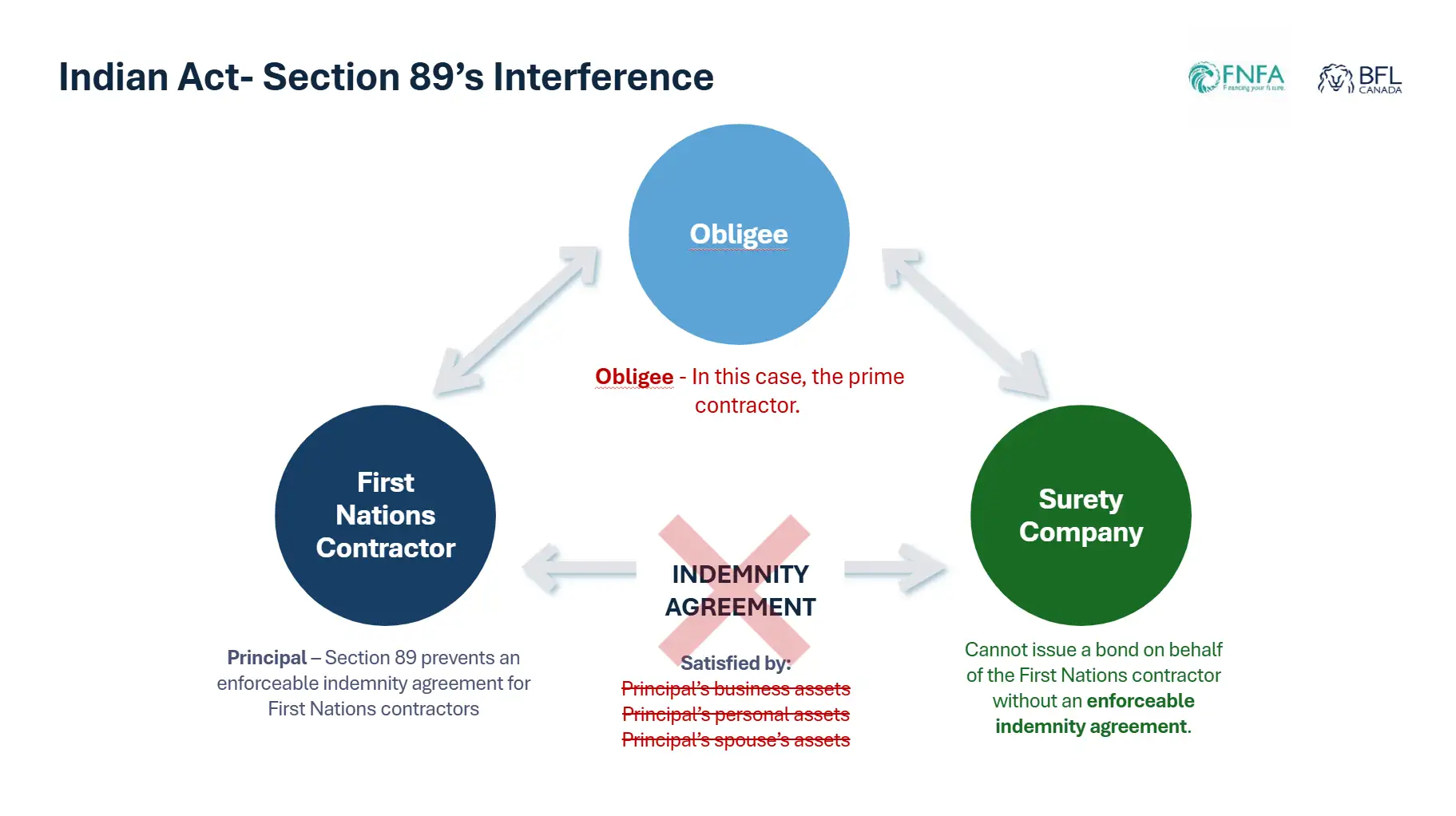
89 (1) Subject to this Act, the real and personal property of an Indian or a band situated on a reserve is not subject to charge, pledge, mortgage, attachment, levy, seizure, distress or execution in favour or at the instance of any person other than an Indian or a band.
Without collateral, First Nations contractors, with assets located on reserve, cannot sign an enforceable indemnity agreement; without indemnity agreements, they cannot obtain surety and bonding insurance, a prerequisite for virtually all major housing, infrastructure, and resource projects. The result is predictable: First Nation contractors are often pushed into subcontractor roles, unnecessary joint-ventures or excluded entirely from the bidding process.
Proposed Solution
- Canada’s 2025-2026 budget announced its intention to explore the creation of a surety and bonding backstop pilot project for First Nations contractors on reserve to enable on-reserve construction companies to bid for infrastructure projects.
- FNFA has established a technical working group to co-develop this pilot with involvement from other subject matter experts.
- FNFA has proposed the establishment of a renewable backstop consisting of funds that can be leveraged to enable the signing of an enforceable indemnity agreement, allowing First Nation contractors to compete for contract bids. If selected as the proponent, then upon successful completion of the contracted job, the leveraged backstop funds would be released and recycled to another contractor interested in bidding on a different project. The long term intended objective is a national rollout in which this model will be made available to all First Nations contractors with assets on reserve who face this barrier. Our goal is equitable access to surety & bonding to allow Indigenous contractors to fairly compete for contracts and grow their economies.
Support the Surety & Bonding Initiative
Your voice matters. If you would like to advocate for this initiative, you can formally submit a letter of support by following these simple steps:
- Download the template
- Complete the document with your organization’s information
- Return the completed letter via email to Theo Chiara, Policy Analyst, at tchiara@fnfa.ca.
Thank you for helping us drive this initiative forward.
Learn More